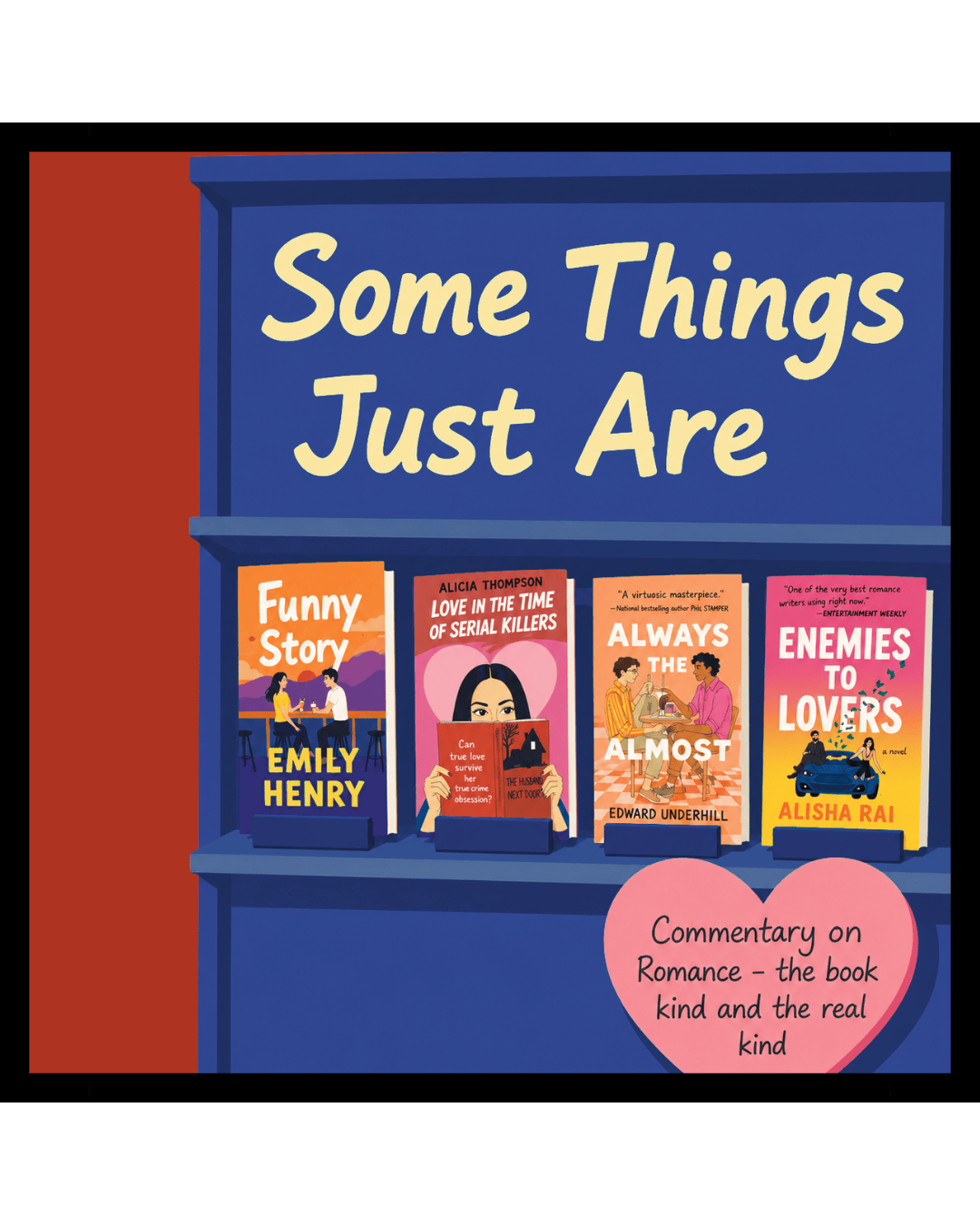
Commentary on Romance – the book kind and real kind
Unsurprisingly, the majority of my reading time is devoted to romance novels. A few mysteries, comedies, sometimes fantasy, and the occasional something else too. But mainly: romance.
In the last few months, some notable romance novels that I’ve read and loved (or came close to loving) are:
- “Funny Story” by Emily Henry — love how the ending complements the beginning. And I think the structure and timeline are interesting. Job well done for being able to get into the male love interest’s head even though the female protagonist is the narrator for the entire book.
- “Love in the Time of Serial Killers” by Alicia Thompson — it would’ve been cool to have the female protagonist believing the neighbor’s a serial killer for longer (even if we know he’s not). That would’ve been a lot funnier. Maybe a little difficult to pull off in first-person but it would’ve been nice to see the effort. As it is, the book fell short of its title. But otherwise a great study on how people become emotionally unavailable when raised by emotionally unavailable parents who are also emotionally dysfunctional couples.
- “Always the Almost” by Edward Underhill — which aptly explores queer identity without being depressing, which is important for me because not gonna lie, a lot of LGBTQ+ stories I’ve read in the past are extremely depressing and I don’t like that. The book also doesn’t shy away from acknowledging that queer characters can be flawed and human and still loveable. You don’t need to protect a character just because they are from a non-White non-heteronormative non-cigender male identity. Unprejudiced readers will acknowledge that there’s a difference between humanizing a character and villainizing them.
- “Enemies to Lovers” by Alisha Rai — narrative voice gets a little sappy at times and I feel like the female character is a little too aware of her own vulnerabilities right from the start, but great voices, very funny, action’s written well, and I love the end scene though it could’ve ended a little earlier.
I am also currently reading “Morbidly Yours” by Ivy Fairbanks — which I’m loving so far. Great character work and distinct narrative voices. And I do like how the author subtly sets up other characters whose lives are highlighted in the sequel. Can’t make any final judgments now because I’m only in Chapter 11, but once I’m done reading, I’ll have more opinions…
If there’s one thing I’ve noticed as a pattern in these books: while there are evidently many concrete reasons we can point to to explain why characters ruin their relationships (like Miles in “Always the Almost” who’s trying to cement both his gender and romantic identity), struggle with romance and commitment (like Sejal in “Enemies to Lovers” who comes from a toxic set of parents or Phoebe in “Love in the Time of Serial Killers” who also comes from toxic parents), and pretend themselves out of love (like Daphne in “Funny Story” who doesn’t want to ruin her most stable interpersonal relationship with her new best friend and roommate), there are evidently not as many concrete reasons that explain why characters fall in love in the first place.
Sure, if we tried, we can make assumptions, we can hypothesize. Maybe we’ll find things Character A likes about Character B and vice versa, but why is that out of all the characters, these two end up together? That these two work? That these two fall for each other?
We can’t know. Not really.
Here’s the thing about attraction and love: they just kinda happen and we just kinda have to believe them.
In writing classes, we were often asked what is it that the characters in a romantic coupling see in each other and I struggled with this question. Because the truth is, not only do I not know this as the author, I’m not sure my characters know either. Maybe it’s hormones, chemistry, or physics. Maybe it’s just luck or fate. A common hobby or workplace. The right time, the right place.
But maybe it doesn’t matter?
Over the years, if you’ve been paying close attention you’ll know, I spent a lot of time pondering my own attractions and relationships: comparing one lover to the next (or potential lover to the next). And all it got me was oversimplified flat versions of who people are or can be. I will admit, I have a type. I very, very, very much have a type: confident, ambitious, passionate, a little self-righteous (I hate to break it to you guys, but you really are, but it’s okay, because I am too and that’s why I’m attracted to it), South Asian or Middle Eastern (brown guys, basically), has to have a beard, taller than me (that’s an important one, especially considering I’m already the shortest one at home!!), and fit and healthy but not photoshopped and not obsessive about what they eat to the point that I can’t cook for them (also a very important one) & there are very few exceptions to these rules. Very few. And they have not worked out. At all.
And yet! If every guy I’ve ever loved (and I do say guy, because the girls are different and we’ll talk about that another time) is essentially the same person, then what’s different?
Well, trust me, they are different.
I could also oversimplify the differences: one is shorter, one is taller; one is musically-inclined, and another really should never sing ever; one is an extreme loner and great to yap at, and yet another cannot survive without constantly yapping at someone. Maybe they play different sports, or drive different cars, or come from different countries, but these alone don’t really dictate attraction, do they?
Take a set of twins with identical lives and identical personalities — will the same person fall for both of them?
Maybe, maybe not.
Will they fall for the same person?
Maybe, maybe not.
And don’t even get me started on how many similarities I notice between me and the girls my exes have finally ended up with… Seriously, just, let’s not. That is an eternal trigger.
Even more a trigger is when people question the love. Was is really love? Aren’t you too young to know love? Too unexperienced? How do you know you love them? Why do you love them? And these are all the wrong questions. These questions are nonsense because love is an emotion. Does anyone question why we love our parents or siblings or friends? Does anyone ask why we love them? No. If someone says they love a parent or a sibling or a friend, we take it for face value. Why can’t we do the same for a crush or a romantic partner or spouse? Why do we need to rationalize those emotions?
Here’s what’s finally given me peace: to stop thinking about the why of it all, and accept that some things just are. And that if you’re happy with the way things are, that’s enough.

